REVIEW · KYOTO
Kyoto: Tea Ceremony with Maiko
Book on GetYourGuide →Operated by B.B.Advisors Inc. AN KYOTO · Bookable on GetYourGuide
A real Maiko, up close, in under an hour. What makes this Kyoto experience stand out is that you get a matcha lesson plus a live Q&A with a working entertainer, all in a tidy 45 minutes. It’s also close to transit, so it’s one of those plans that fits even when your Kyoto time is tight.
I love two parts most: first, making my own cup of matcha with guidance, not just watching; second, the photo chance right beside the Maiko plus the lucky charm called Senjafuda. The Q&A also feels less like a script and more like getting a window into daily life.
One thing to consider: the venue isn’t an ochaya or a traditional house. It’s in a building (with stairs), so if you’re expecting a long, candlelit, classic tea-room atmosphere, you might find it more relaxed and straightforward than that.
In This Review
- Key takeaways before you go
- Why this Kyoto Maiko tea ceremony is a smart fit
- Gojo Station meeting point: fast to find, easy to build into a day
- Tea ceremony with a Maiko: what happens in the room
- The sweets: small, but part of the Kyoto idea
- Q&A with Maiko or Geiko: the real value is direct conversation
- A note on expectations
- Photos right beside her: how to make the moment count
- Senjafuda lucky charm: why this souvenir feels more meaningful
- Price and value: what you get for about $28
- Who should book this (and who might skip it)
- Practical tips to avoid frustration on the day
- Don’t underestimate the building stairs
- Timing is part of the deal
- Translation support exists, but expect it to be helpful-not-perfect
- Children and seating rules
- Maiko vs Geiko on the day
- Should you book the Kyoto Maiko tea ceremony?
- FAQ
- Where is the meeting point?
- How long does the experience take?
- Is this held in a traditional ochaya house?
- Will I get to make matcha, or only watch?
- Do I get a photo with the Maiko or Geiko?
- What souvenir do I receive?
- Is there an English translator?
- Is the ceremony conducted by a Maiko for sure?
- Is the venue wheelchair accessible?
- What about children?
Key takeaways before you go
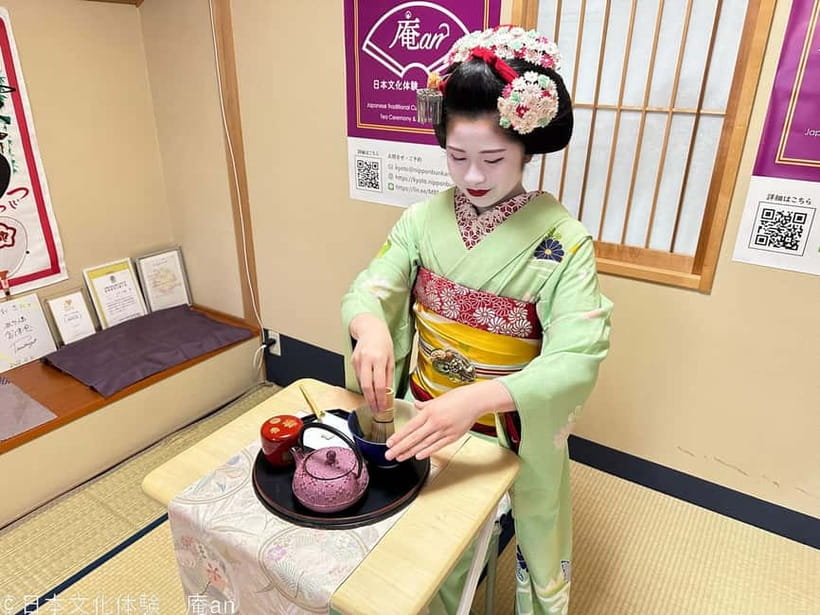
- Hands-on matcha: you’ll make your own tea, not just taste it
- Q&A access: ask questions directly and learn about her world
- Senjafuda lucky charm: you leave with a meaningful souvenir
- Close photo moment: commemorative pictures right beside the Maiko
- Maiko or Geiko: your host may be a Maiko or a Geiko depending on the day
Why this Kyoto Maiko tea ceremony is a smart fit
Kyoto can swallow your whole day fast. Between shrines, walking routes, and suddenly realizing you missed lunch, it’s easy to lose time. This experience is built for that reality: 45 minutes, near a major transit stop, and packed with Kyoto symbols in a small, focused format.
At the heart of it are two things you’ll recognize right away. Tea is part of Kyoto’s everyday elegance, and the Maiko world is one of its most famous living traditions. Here, you get both at the same time—matcha in your hands, and a real person answering your questions face to face.
I also like the fact that the program keeps it simple. There’s no “learn Japanese first” requirement or special dress code. You show up, meet your host, and the staff keeps the timing smooth so you’re not waiting around for a long setup.
You can also read our reviews of more tours and experiences in Kyoto.
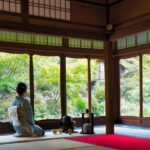
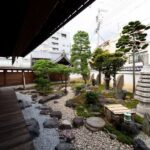
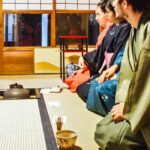
Gojo Station meeting point: fast to find, easy to build into a day
The meeting point is a 1-minute walk from Exit 1 of the Subway Karasuma Line Gojo Station. The storefront entrance faces Gojo-dori (the main street), so you’re not hunting through an alley maze for an hour.
If you want a practical navigation tip, use this approach:
- Exit 1
- Walk straight, cross a small street
- Keep going until you spot the location above the supermarket Carnival
- Go up the stairs and look for the entrance
That extra “Carnival” landmark is worth using because the area can feel confusing if you’re arriving without a clear visual reference.
The practical win here is timing. When your Kyoto day is already full, this is a plan that doesn’t require you to reorganize everything around it. You can slot it between other activities instead of treating it like a whole separate day.
Tea ceremony with a Maiko: what happens in the room
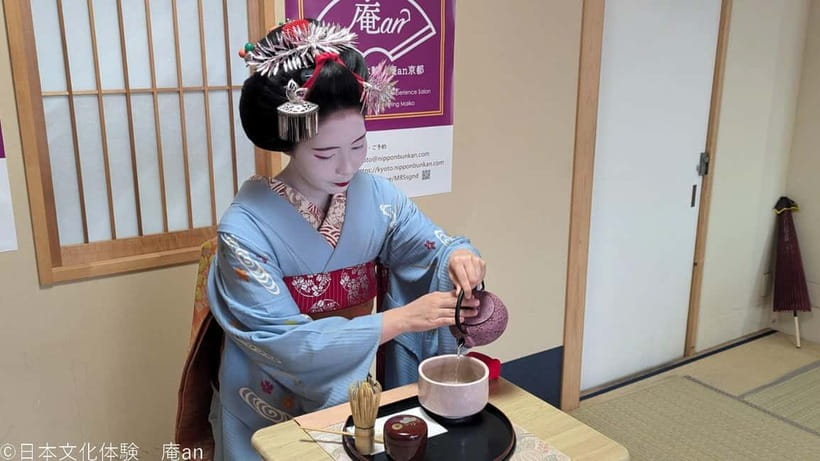
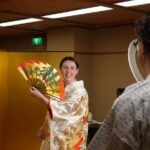
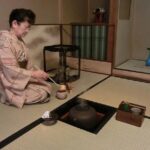
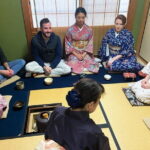
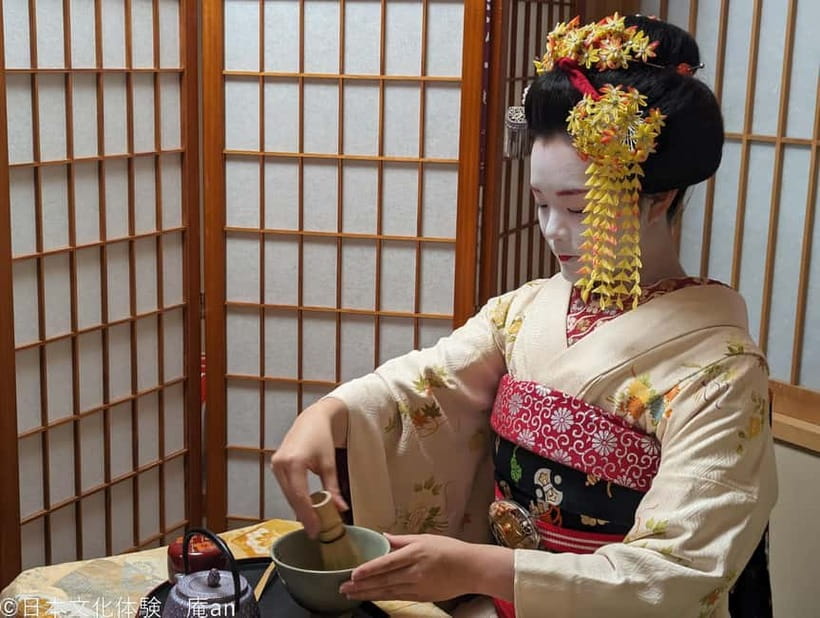
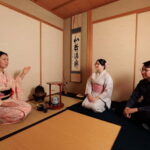
This experience is guided by a Japanese instructor, and your host is either a Maiko or, depending on the date and situation, a Geiko. Either way, the core flow is the same, and the purpose is the same: you learn the form while participating.
From the moment you start, expect this rhythm:
- Greeting from your host
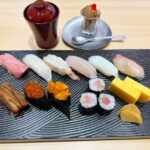
- Tea ceremony with matcha and two dried-type Japanese sweets
- A hands-on moment where you make your own tea
- Q&A session
- Photos next to your host
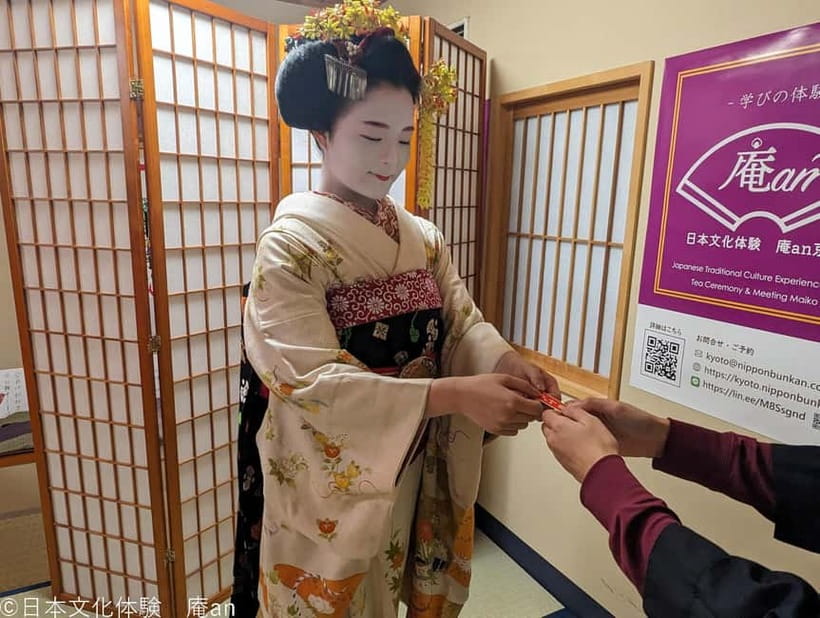
- A Senjafuda lucky charm gift
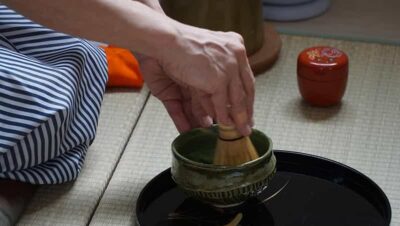
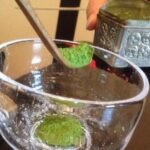
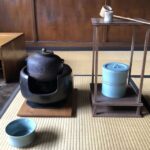
The ceremony itself is not just a performance. You’ll learn how to make matcha and then do it yourself. That’s a big deal. Watching tea being prepared can be pretty, but making the tea gives you a concrete memory—what powder looks like before it mixes, the feel of the steps, and the payoff in the cup.
The sweets: small, but part of the Kyoto idea
You’ll be served two dried-type Japanese sweets alongside your matcha. Even though it’s a small portion, it matters because tea ceremony food often plays a role in the pacing and flavor balance. It also keeps the experience from being only one note.
If you’re the type who likes learning by doing, this part helps. It’s another sensory cue during a short program, so your brain stays engaged instead of drifting while you watch.
Q&A with Maiko or Geiko: the real value is direct conversation
The most meaningful part for me isn’t the tea itself—it’s the chance to ask questions directly. The program includes a Q&A session, and the point is not just politeness. You’re meant to learn about daily life, and your host can explain how she thinks about her work and how she fits into the traditions.
This is also where the experience becomes personal. You’re not relying on an audio guide or a brochure. You get answers in real time, and staff can help with English translation as much as possible. If you want added translation support, you’re told to contact them.
Some bookings have also noted extra cultural touches during the session, like discussion around other traditional drinks and activities. But don’t assume your particular session will include anything beyond what’s built into the flow. The core remains matcha-making, sweets, Q&A, and photos.

A note on expectations
Because you may be hosted by a Maiko or Geiko, your conversation might feel slightly different depending on who’s in the role that day. The good news is that both bring a strong perspective on the performing arts world, and the program is set up to give you access either way.
If your goal is learning how these traditions are lived, not just observed, the Q&A is the section that delivers.
Photos right beside her: how to make the moment count
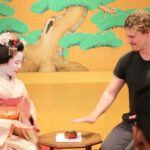
You’ll have a photo opportunity where you take a commemorative picture right beside your Maiko (or possibly Geiko). This is not a distant “wave from the corner” situation. It’s close enough to feel like you’re actually part of the moment.
A simple way to get better results: decide your photo plan before you step in. For example, know whether you want:
- one close portrait
- one wider shot that includes the full setup
- a couple quick poses so you’re not fumbling with your camera during the best moment
You also get a special gift right after the photo moment: a Senjafuda lucky charm. That means the photos aren’t just for fun. They become tied to an actual keepsake from the ceremony.
Senjafuda lucky charm: why this souvenir feels more meaningful
The Senjafuda gift is a standout detail. A lot of Kyoto souvenirs are pretty, but they’re still just objects. Here, the charm comes directly from your host as part of the ceremony flow.
That connection is what makes it feel like a real memory, not a random purchase. It also adds emotional weight to the experience: you’re not just leaving with photos, you’re leaving with something you were given as part of the interaction.
If you’re the kind of traveler who likes taking home a story, this is one of the best “value add” items in the whole package.
Price and value: what you get for about $28
At $28 per person for about 45 minutes, this is reasonably priced for what’s included. You’re not paying only for a chair-and-watch tea show. You’re getting:
- tea ceremony with a Maiko (or Geiko)
- instruction and a chance to make matcha yourself
- two dried-type Japanese sweets
- a Q&A with your host
- photos beside your host
- a Senjafuda lucky charm gift
When you break it down, that inclusion list is the value. Even in a short time, you’re participating, talking, learning, and leaving with a tangible token.
Also, because it’s close to Gojo Station, you reduce the “hidden costs” of time. You’re not losing half a day just getting to and from a faraway location. That practical convenience is part of why the package feels worth it.
Who should book this (and who might skip it)
This experience fits best if you want:
- a short Kyoto plan that still feels culturally real
- hands-on matcha rather than passive viewing
- direct Q&A with a real host
- photos you’ll actually want to keep
You might reconsider if you:
- expect a full traditional ochaya-style setting in a classic Japanese house
- hate stairs (there’s no elevator in the building)
- are very sensitive to timing and late arrivals, since you’re told the event won’t be held for delays and latecomers won’t receive a refund
If you like your Kyoto experiences short, focused, and human-scale, this is a strong match.
Practical tips to avoid frustration on the day
Here are the details that matter most for a smooth experience.
Don’t underestimate the building stairs
There’s no elevator. You’ll need to take stairs to reach the venue. If you have mobility constraints, plan around that.
Timing is part of the deal
The program has set timing and it’s not flexible for late arrivals. That means you should build a little buffer into your schedule, especially if you’re also hopping between Kyoto stops that day.
Translation support exists, but expect it to be helpful-not-perfect
English translation is provided as much as possible. If you’d like to add more translation support, you’re instructed to contact them.
In practice, that means you’ll likely be able to understand the main points and ask questions. Still, your best strategy is to come with a few simple, curious questions about her daily routine, the training path, and what certain tea steps mean.
Children and seating rules
Children who sit on a parent’s lap are free of charge if they’re under 2. Children who need their own seat pay the same fee as one person.
Maiko vs Geiko on the day
Depending on the date, your experience could be hosted by either a Maiko or a Geiko. The good part: the program is still built to deliver the tea, the Q&A, photos, and the Senjafuda gift.
Should you book the Kyoto Maiko tea ceremony?
If you’re deciding whether this is worth your time in Kyoto, my advice is: book it if you want a compact experience that combines matcha-making with real conversation and a souvenir you’ll actually keep.
I’d skip it only if you’re chasing the most traditional-looking venue possible or you’re worried about stairs and strict timing.
One more helpful mindset: treat this as a conversation you can participate in, not a long museum-style lesson. You’ll get more from it if you show up curious and ready to ask.
FAQ
Where is the meeting point?
It’s a 1-minute walk from Exit 1 of the Subway Karasuma Line Gojo Station. The store entrance faces the main street, Gojo-dori.
How long does the experience take?
The experience runs about 45 minutes.
Is this held in a traditional ochaya house?
No. The venue is located in a building, not an ochaya or traditional Japanese house, though it offers a relaxed atmosphere and friendly staff.
Will I get to make matcha, or only watch?
You’ll learn how to make matcha and then make your own tea by yourself.
Do I get a photo with the Maiko or Geiko?
Yes. You’ll have a photo opportunity right beside your host as part of the program.
What souvenir do I receive?
You receive a lucky charm called Senjafuda.
Is there an English translator?
English translation is provided as much as possible. If you want to add English translation support, you’re asked to contact the operator.
Is the ceremony conducted by a Maiko for sure?
Depending on the event date and situation, the host may be either a Maiko or a Geiko.
Is the venue wheelchair accessible?
The building has no elevator, so you’ll need to use stairs to reach the venue.
What about children?
Children who sit on their parent’s lap are free of charge if they’re under 2 years old. Children who require their own seat pay the same fee as one person.