REVIEW · BEIJING
Beijing Culture: Tea Ceremony, Heritage Instrument & Calligraphy
Book on Viator →Operated by Culture Heritage Tour China · Bookable on Viator
Tea, strings, and ink in one calm room. This workshop takes you into China’s living arts at a private Beijing venue, away from big crowds and staged performances. In about 2.5 hours, you’ll learn the rituals behind tea ceremony, Guqin, and calligraphy with national-level cultural masters.
I especially like the chance to do more than watch. You’ll get a real tea tasting with a tea master, plus hands-on Guqin guidance that helps you play a full melody rather than just hearing it.
One thing to consider: transport isn’t included, so you’ll want a plan to reach 813 Creative Park on time. If you’re hoping for a door-to-door service from central hotels, this may take a bit more effort.
In This Review
- Key highlights you’ll actually feel
- Entering the experience at 813 Creative Park (not a tourist theatre)
- Tea ceremony in Beijing: tasting, breathing, and learning the meaning
- Guqin music: from a live performance to playing a full melody
- Chinese calligraphy workshop: writing characters and taking your work home
- Traditional outfit rental: a ritual feel, not a costume contest
- How the small group format helps you learn (max 8 matters)
- Price and value: $78.60 for three masters, not three shows
- Practical tips so your session goes smoothly
- Who should book this Beijing tea, Guqin, and calligraphy session
- Should you book it?
- FAQ
- FAQ
- Where does the experience start?
- How long is the workshop?
- What activities are included?
- Is transportation to and from the venue included?
- How big is the group?
- What language is the guide?
- Do you get a traditional outfit?
- Is good weather required?
- When do I get confirmation?
Key highlights you’ll actually feel
- Three core practices in one session: tea, Guqin, and calligraphy
- Small group size (max 8) makes the learning personal
- National-level artists and masters guide you, not actors running a script
- Hands-on instruction: you write characters and learn a Guqin melody
- Traditional outfit rental for the ritual and photos
Entering the experience at 813 Creative Park (not a tourist theatre)
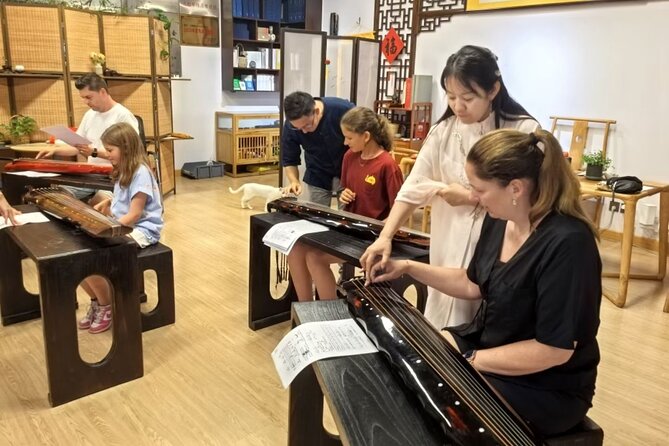
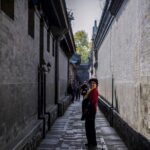
This experience starts at 813 Creative Park in Chaoyang District, right at the meeting point listed for the tour. The venue is described as a quiet heritage space that’s closed to the public, which matters in Beijing. You’re not fighting lines, noise, or the feeling that you’re watching something meant only for visitors.
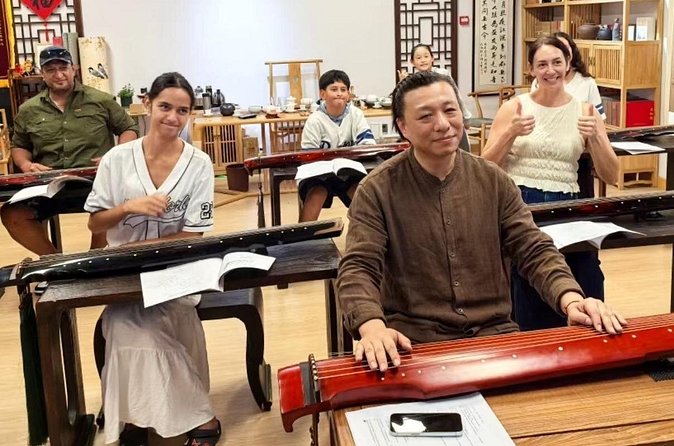
The session runs about 2 hours 30 minutes and uses a mobile ticket, so it’s pretty straightforward once you’re there. Also, the group is capped at 8 travelers, and that small size changes the vibe fast: you can ask questions, get help with your brushstrokes or finger placement, and actually absorb what you’re doing.
English guidance is part of the package too. The guide is described as bilingual, with an M.A. in History & Sociology, so you get more than how-to steps—you get the why behind the ritual choices.
You can also read our reviews of more tours and experiences in Beijing.
Tea ceremony in Beijing: tasting, breathing, and learning the meaning
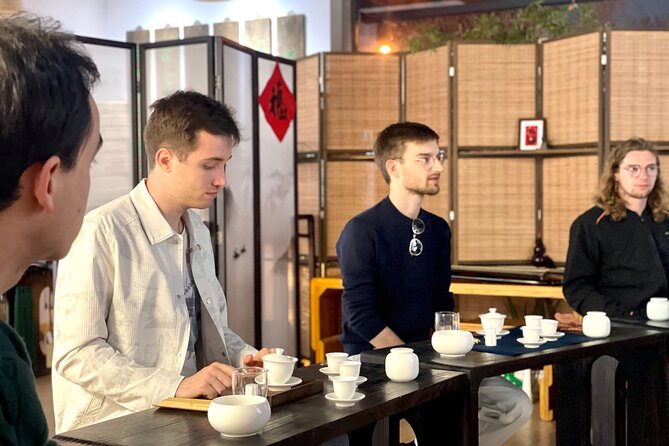
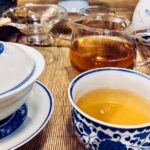
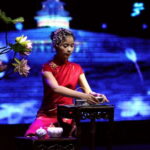
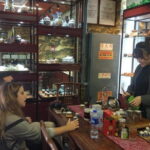
The tea portion isn’t just a pour-and-smile moment. You’ll do a traditional tea ceremony and tea tasting with a certified tea master, and the emphasis is on understanding the rituals and elegance behind each step.
Here’s what makes this useful for you, even if you don’t know Chinese tea etiquette. The ceremony is designed to slow you down. You’ll learn how the process shapes the taste and the experience, not just the final flavor in the cup. That’s why it’s often described as peaceful, quiet, and emotionally moving—because the pace is the point.
In a typical sightseeing day, your brain stays on fast-forward. This workshop forces you to switch modes. You pay attention to heat, aroma, and the order of actions. Then you taste what you made. That combination—doing the ritual and drinking the result—is what turns tea from a background detail into a real cultural moment.
If you’re the kind of traveler who likes “learning with your hands,” this tea segment is one of the best parts. You’re not waiting your turn for a staged demonstration.
Guqin music: from a live performance to playing a full melody
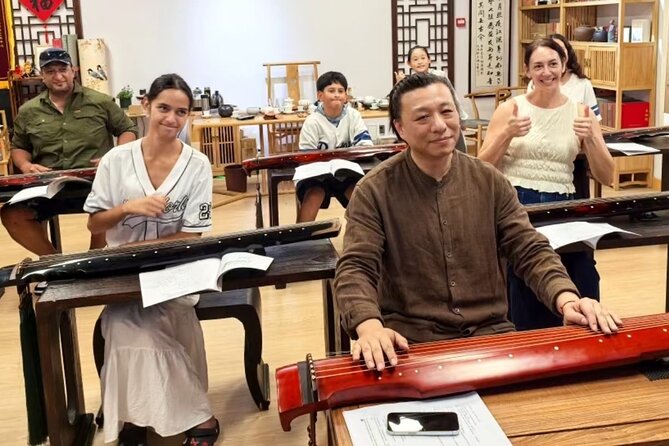
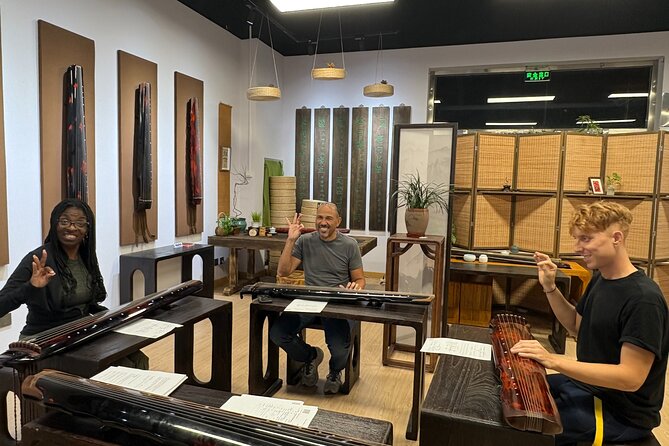
Next comes the Guqin, China’s revered ancient instrument. You’ll first hear a live Guqin performance by a national-level heritage artist. Then you move from listening into doing: there’s a hands-on Guqin learning session.
What I like about this format is simple. Listening helps you map the sound in your head. Then the teacher can guide your fingers and posture while you attempt a melody. You’re not stuck with vague tips; you’re working toward the goal of playing something that feels like a complete piece, not just a couple of notes.
The Guqin isn’t loud like some modern instruments. It’s quiet, and it rewards focus. That fits the overall tone of the workshop. People often describe the Guqin session as goosebump-level moving because it feels intimate—like the music is happening in the same room with you, not bouncing off a stage.
Practical note: you don’t need to already know music. The session is set up for participation, and the teaching is guided in English. Still, go in with patience. Learning finger placement takes time, especially with an instrument that doesn’t follow the same muscle memory as guitar or piano.
Chinese calligraphy workshop: writing characters and taking your work home
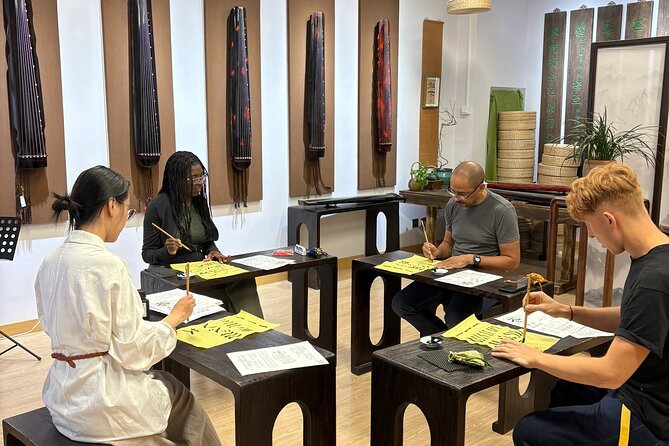
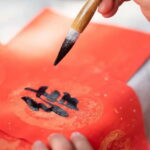
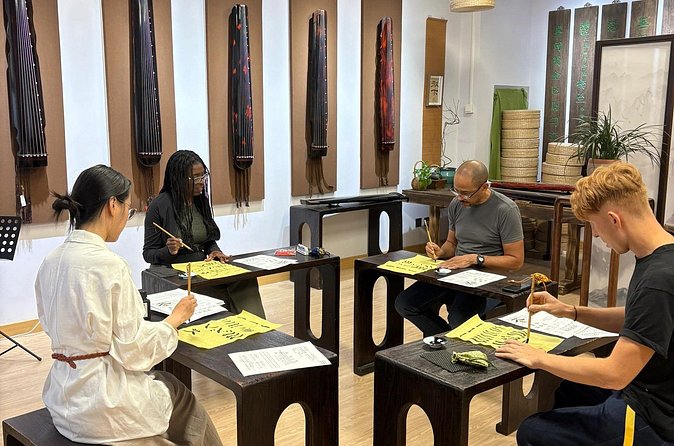
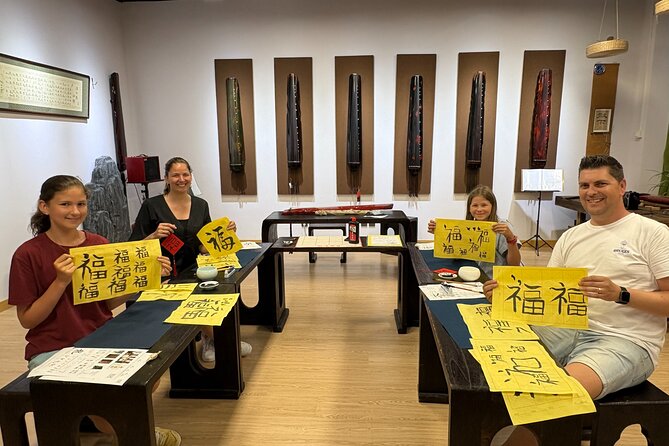
After tea and Guqin, you’ll do Chinese calligraphy with expert guidance. The focus is on writing real Chinese characters and understanding their ancient roots—so you’re not only copying pretty strokes. You learn what the structure means and why the brushwork follows specific rules.
This is the hardest activity on most people’s first try, simply because brush control isn’t automatic. But that’s also why it’s satisfying. Once the teacher shows you how to hold the brush and approach the strokes, your brain clicks into a slower rhythm.
One of the most memorable outcomes reported is help writing a personal character result—people get guidance on writing their Chinese name—and then they take the written sheet home. That makes the calligraphy part more than a class. It becomes a keepsake you can frame or display, especially if you want a souvenir that isn’t mass-produced.
If you want to maximize this segment, consider bringing the Chinese characters for your name (if you have them). If you don’t, the guide can still help you participate; the workshop is designed for most travelers. Just don’t expect perfect-looking results on the first go. The point is progress and understanding, not perfection.
Traditional outfit rental: a ritual feel, not a costume contest
You’ll also have traditional outfit attire rental included. This is for the ritual and for photos, and it helps you step into the mood of the culture-focused session.
I like the way this is handled when it’s tied to the actual practice. The outfit isn’t a random photo-op stuck onto a workshop. It’s there because tea, Guqin, and calligraphy share a cultural tone: quiet respect, slow attention, and careful performance.
Bring comfortable clothing under the outfit. You’ll be sitting and moving gently through the workshop, so you don’t want tight shoes or stiff layers that make sitting awkward. Also, if you’re camera-ready, this is the best time to grab photos—because the setting is calmer than most city sights.


How the small group format helps you learn (max 8 matters)
This experience caps at 8 participants, and that’s a big deal for three reasons:
First, it keeps the energy controlled. The tea tasting and Guqin session rely on quiet concentration. Too many people and the whole atmosphere breaks.
Second, it gives the instructors time. Calligraphy especially benefits from direct guidance. You can get feedback on brush angle, stroke direction, and pacing without feeling rushed.
Third, it makes the English guidance more useful. A bilingual guide with an M.A. in History & Sociology isn’t just translating phrases. The session is framed around meaning—ritual and philosophy—so questions are encouraged and answers can stay on-topic.
If you’re the sort who likes talking in small groups, this fits you. If you prefer big-group energy and nonstop movement, you might feel slower than you expected. But that slowness is the point.
Price and value: $78.60 for three masters, not three shows
At $78.60 per person for about 2.5 hours, you’re paying for more than a ticket. You’re getting three separate cultural skills taught in one setting: tea ceremony with tasting, Guqin performance plus learning, and calligraphy instruction. All of it is guided by national-level cultural masters and supported by an English-speaking bilingual guide.
Here’s how I’d judge value for you:
- Hands-on instruction matters. Many cultural experiences are mostly passive. This one has you brewing, writing, and learning an instrument.
- Small group size reduces the cost of instructor attention. With a max of 8, your time with the teachers is more real than the quick wave-and-move approach you see elsewhere.
- The venue is private and closed to the public, which helps you feel the difference between a real practice space and a show floor.
Also, the booking cadence is notable—on average it’s booked about 51 days in advance, which suggests it’s not something that always has last-minute availability. If you want it on your schedule, treat it like a real appointment, not a spontaneous add-on.
Practical tips so your session goes smoothly
A few small things can make the experience feel effortless instead of stressful:
- Plan to arrive a little early. The start point is specific—813 Creative Park—and you’ll want time to find it calmly.
- Wear comfortable clothes you can sit in for a while, since tea, Guqin guidance, and calligraphy all take time.
- Bring questions about tea, calligraphy, or the Guqin’s role in Chinese culture. The guide’s background suggests you’ll get thoughtful answers, not just factual definitions.
- Use the outfit time. If you want photos, do it without dragging the whole group pacing—teachers can usually guide the rhythm of the session.
If weather affects your plans, know that this experience requires good weather and may be canceled if conditions are poor. If that happens, you’ll be offered a different date or a refund.
Who should book this Beijing tea, Guqin, and calligraphy session
Book it if you want more than landmarks. This is for you if you like:
- Hands-on cultural learning instead of watching from a seat
- Quiet, focused time with tea, music, and writing
- A small-group setting where you can actually interact
- A deeper look at ritual and meaning, not just surface-level facts
Skip it if your trip style is all about speed and big outdoor sights. This workshop is calm by design. You’ll trade some sightseeing momentum for a different kind of memory—the kind you can recreate at home with tea aroma in your memory and a sheet of calligraphy in your hands.
Should you book it?
Yes, you should strongly consider booking if you want a Beijing experience that feels personal, practiced, and real. For the price, the value comes from participation: brewing and tasting, learning a Guqin melody, and writing characters with guidance. That’s a rare combo, and the small group size keeps it from turning into a routine tourist stop.
If you only care about checking boxes—top sights with quick photos—then you might prefer something louder. But if you want to slow down and learn living tradition, this is the kind of booking that pays off for weeks afterward.
FAQ
FAQ
Where does the experience start?
It starts at 813 Creative Park (Chaoyang District, Beijing), at the meeting point listed for the tour. The activity ends back at the meeting point.
How long is the workshop?
The duration is about 2 hours 30 minutes.
What activities are included?
You’ll do a traditional tea ceremony and tea tasting, enjoy a live Guqin performance plus a hands-on Guqin learning session, and complete a Chinese calligraphy workshop with expert guidance.
Is transportation to and from the venue included?
No. Transportation isn’t included, so you’ll need to get yourself to the meeting point.
How big is the group?
This experience has a maximum of 8 travelers.
What language is the guide?
You’ll have a bilingual guide and the experience is guided in English.
Do you get a traditional outfit?
Yes. Traditional outfit attire rental is included for ritual and photos.
Is good weather required?
Yes. The experience requires good weather. If it’s canceled due to poor weather, you’ll be offered a different date or a full refund.
When do I get confirmation?
You’ll receive confirmation within 48 hours of booking, subject to availability.